
How it all started...
Palos Park was a small community of summer cottages and farms in 1898 when a visiting school teacher from Michigan (Miss Lane) started a summer Sunday School program for area residents and vacationers. That program continued through 1899, met in a tent in 1900, and culminated with the building of a small chapel in 1901. The group incorporated as the Palos Park Sabbath Union. 1902 brought changes to the church constitution and a new name, the Palos Park Evangelical Church. In 1903 the name was again changed, to The People's Church of Palos Park, and in 1921 the church affiliated with the Presbyterian church U.S.A. A leading reason for the affiliation was to insure a constant source for the hiring of pastors, and none of the members of that congregation had previously been a member of a Presbyterian church.
In 1931 an addition was built onto the structure and the church became the Palos Park Presbyterian Church. In 1950, in an era of rapid Post-war growth, the church was renamed the Palos Park Presbyterian Community Church (PPPCC). An addition of a second sanctuary, which would give the building an "L" shaped footprint, was begun in 1950 and finished in 1952, to accommodate a membership that had grown to over 300. The last addition of a large sanctuary and chapel, with a kitchen and fellowship hall, was completed in 1959. On the dedication of the new sanctuary in 1960, church membership reached 850. The previous sanctuary, now connecting the original and newest sanctuaries, was converted to offices and classrooms.
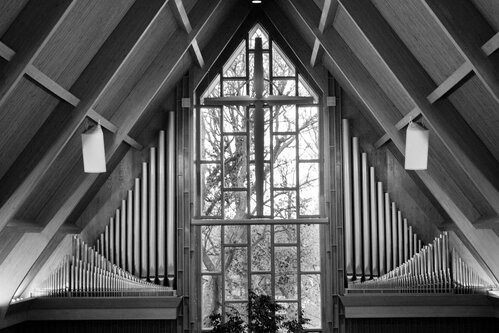
A new manse was custom built in Palos Park in 1963. These last changes were completed during the tenure of the longest serving pastor of that earlier time, Dr. Paul Lundell, 1956-1982. Rev. James R. Tony was called to the senior pastorate of PPPCC in 1990, and beginning in 1993, capital campaigns led to a remodeled Fellowship Hall, full air conditioning throughout the church, paving and purchasing of a current and new parking lots, landscaping, new sound and speaker systems for the sanctuary, remodeling of the chancel area, and the purchase of additional improved property suitable for another manse or development. In 1997, a new organ console designed and built by the Peterson Organ Company debuted along with 1350 new and rebuilt pipes which had been installed in chambers behind the chancel that had been only partially filled since 1959.
In 1998, PPPCC marked 100 years of Christian education in Palos Park, and in 2001 we celebrated our centennial with a year-long celebration of events culminating in a Jubilee Weekend and dinner. The centennial theme was the appropriately named "2001- a Faith Odyssey." In 2004 we had our Resourcing the Vision capital campaign. Through this campaign, we were able to acquire a valuable piece of property adjacent to the church which will greatly assist in future expansion. Our congregation has made a careful effort to maintain the church's various properties over time, including a major renovation of the manse in 2015. We have been faithful in our stewardship and have recognized God's many blessings throughout the years.
In 1931 an addition was built onto the structure and the church became the Palos Park Presbyterian Church. In 1950, in an era of rapid Post-war growth, the church was renamed the Palos Park Presbyterian Community Church (PPPCC). An addition of a second sanctuary, which would give the building an "L" shaped footprint, was begun in 1950 and finished in 1952, to accommodate a membership that had grown to over 300. The last addition of a large sanctuary and chapel, with a kitchen and fellowship hall, was completed in 1959. On the dedication of the new sanctuary in 1960, church membership reached 850. The previous sanctuary, now connecting the original and newest sanctuaries, was converted to offices and classrooms.
A new manse was custom built in Palos Park in 1963. These last changes were completed during the tenure of the longest serving pastor of that earlier time, Dr. Paul Lundell, 1956-1982. Rev. James R. Tony was called to the senior pastorate of PPPCC in 1990, and beginning in 1993, capital campaigns led to a remodeled Fellowship Hall, full air conditioning throughout the church, paving and purchasing of a current and new parking lots, landscaping, new sound and speaker systems for the sanctuary, remodeling of the chancel area, and the purchase of additional improved property suitable for another manse or development. In 1997, a new organ console designed and built by the Peterson Organ Company debuted along with 1350 new and rebuilt pipes which had been installed in chambers behind the chancel that had been only partially filled since 1959.
In 1998, PPPCC marked 100 years of Christian education in Palos Park, and in 2001 we celebrated our centennial with a year-long celebration of events culminating in a Jubilee Weekend and dinner. The centennial theme was the appropriately named "2001- a Faith Odyssey." In 2004 we had our Resourcing the Vision capital campaign. Through this campaign, we were able to acquire a valuable piece of property adjacent to the church which will greatly assist in future expansion. Our congregation has made a careful effort to maintain the church's various properties over time, including a major renovation of the manse in 2015. We have been faithful in our stewardship and have recognized God's many blessings throughout the years.

Expanding the vision...
After 100+ years of existence and having housed generations of faithful PCC congregants, the building of Palos Community Church needs some attention. In the spring of 2026 we launched the Greater Than Capital Campaign to fund the next big phase for Palos Community Church through a full building remodel. Once again, God demonstrated His faithfulness, and our pledge goal of $700,000 was surpassed by more than 50% with over $1,100,000 pledged toward the campaign between 2026 and 2029. Renovations are set to begin in the fall of 2026. This remodel will not only improve the look of PCC but will ensure the future home of our church for decades to come by addressing issues throughout - updating hvac, electrical and plumbing systems, making the whole building accessible to every attendee, and reworking the existing footprint of our building to be functional for our congregation's needs today and moving forward.